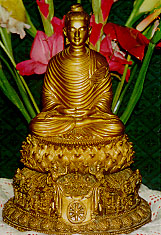
Sculptures were the first significant art of Thailand. They were the expression of religion. Buddhist art was influenced by Sri Lanka due to the similarities of religion. The southern Thailand people were predominantly Mon and professed Theravada Buddhism. Gupta image was the earliest influence on Thai sculptures of earthenware, stone, and metal.
The stone sculpture of the Buddha from the Mon-Dvaravati period, 7th century C. E., is 53 1/4" tall. This was one of the first art forms that remained a favorite religious expression. This stone figure has similar qualities to the Gupta period art in India. In this particular piece , the garment he is wearing , drapes fluidly over his shoulder and down his back. This shows his flawless shape and gives his figure subtle curves. This art seems to be very simple. There aren't extravagant details of jewelry or designs. The simpleness of the art allows you to see the details of his face and head. His hair done in perfect neat curls in perfect symmetric rows on the crown of the head is a bun, a lotus bud. This lotus bud signifies her wisdom. His body has a distinct pose. He has a slight curve in his waist, both arms elevated at an angle with one higher than the other, and his feet planted firmly on the ground with one foot in front of the other.
In the 14th century C. E. the statue of the Walking Buddha bronze in contrast to the earlier statue which was stone. The bronze Buddha seems to be unnatural. The shoulder seems to be very broad, the arms are elongated, yet fluid like. The figure is voluptuous with an increased sense of femininity and sensuality, and it may denote fertility. The bud on his head is much more exquisite than . On top of the lotus bud is affixed a flame. This is the flame of his wisdom that keeps burning.
These pieces of religious art from Thailand art are beautiful. The art symbolizes their devotion to the Buddha. Just looking at their art you can determine, religion plays a big role in their lives, tradition, and their culture.
Written by, Anna Tong
Web Design, Kevin Dunn